


Every article about "going digital" shows a massive, pristine factory floor where robotic arms do all the work and computers run the entire show. It looks impressive, but it also feels completely detached from the reality of running a 15-person CNC machine shop.
If you are running a smaller shop, you don't need a big tech budget or a full-on IT department. You just want a shop floor where things run smoothly. You want your guys to spend less time digging through folders for drawings, less time manually typing data into two different programs, and more time actually making parts.
In this article, we are going to break down exactly how to do that without upending your entire business.
Is the industry really lagging?
Evaluating your daily workflows is about long-term profitability, not just buying software for the sake of it. But it is a fair question to ask: Are smaller machine shops actually falling behind, or is "digital lag" just marketing fluff?
The data shows that the gap between physical machining power and digital office work is entirely real. While machine shops are quick to buy advanced, multi-axis CNC machinery, the front office often remains stuck in the past.
Here is what the actual industry benchmarks show:
- The Small-Shop Divide: Industry adoption studies show that small machine shops lag far behind large manufacturers in software adoption. Surveys from the National Association of Manufacturers reveal that a vast majority of small and medium-sized manufacturers still rely on manual clipboards, local spreadsheets, or paper-heavy workflows to run daily operations.
- The Quoting Bottleneck: Slow paperwork actively hurts your win rate. Industry surveys show that over 67% of custom part buyers expect a quote within 24 hours. Yet, shops relying on manual spreadsheets often take two to three days to estimate jobs, causing them to lose up to 70% of their bids to faster competitors.
- The Tribal Knowledge Risk: With a huge portion of the manufacturing workforce heading toward retirement, keeping knowledge locked in people's heads is a major risk. If critical setup instructions exist only in the memory of a single senior machinist, your entire production capacity has a single point of failure.
Four stages of machine shop digital maturity
To make your shop more efficient, you need to know your starting point. Digital transformation in machine shops is not an all-or-nothing milestone, but rather a step-by-step progression. By identifying where your business sits today, you can map out a realistic path forward without overwhelming your team or your budget.
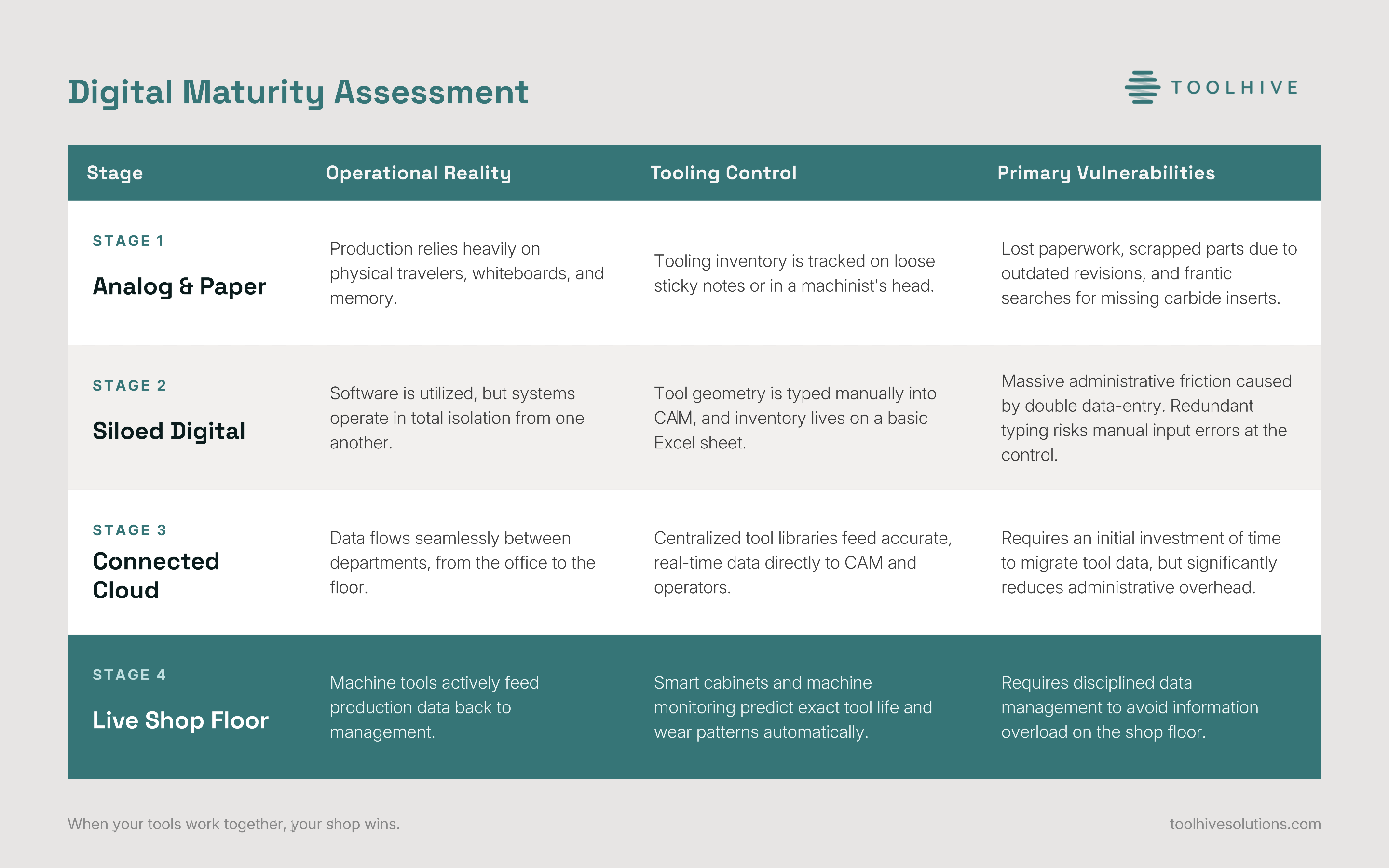
Most small to medium-sized machine shops live right in the transition between Stage 1 and Stage 2. For example, you're using CAM software to program complex parts and a spreadsheet to keep track of your tool data, but those systems do not speak to each other. This creates an invisible bottleneck known as "data re-entry friction," where every manual copy-paste or hand-written note introduces a risk of human error.
The main goal of modernizing your operations is to systematically fix those gaps where your team is forced to wait, guess, or retype data.
Three high-ROI quick wins
You do not need to overhaul your entire business overnight to see a major impact on your bottom line. Focusing on a few specific, high-friction areas yields immediate results. Here are three practical upgrades that protect your workflow and boost profitability.
Win 1: Centralize your tool data
If your tool information lives in spreadsheets, setup sheets, and people's heads, this is the single highest-impact change you can make. Moving your tool library, assemblies, and cutting data into a dedicated tool management system means everyone works from the same source, repeat jobs don't get rebuilt from scratch, and it dramatically helps reduce CNC setup time. It's the first real step out of the manual stage, and you’ll feel the difference almost immediately.
Win 2: Digitize your setup documentation
Setup sheets are one of the most valuable records in a shop, and also one of the most commonly lost, outdated, or stuck in a binder nobody opens. Moving them into a digital system, tied directly to the jobs and tools they belong to, saves time on every single repeat job.
Win 3: Implement digital quoting
Manual estimating on spreadsheets is slow, tedious, and prone to calculation errors. Shifting to data-driven estimation changes how you interact with customers. Digital quoting software accelerates turnaround times by automatically analyzing 3D CAD models for geometry and material volumes. By matching the part geometry against your digital tool library, you can instantly see if you have the right cutters in stock, allowing you to send an accurate quote back in minutes.
Building a resilient shop
Modernizing your machine shop is all about removing risk and building capacity. By making sure your team has instant, digital access to the correct drawings, setup notes, and schedules right at the machine tool, you protect your operational efficiency and keep a strong competitive edge.
You do not need to change how you do everything in a week. Pick your single biggest headache, whether it is slow quoting, lost setup notes, or a chaotic tool data, and take the first step to digitize it.